
Feeling Visual Motion: Mitigating Cybersickness in VR Using Tactile Motion Cues
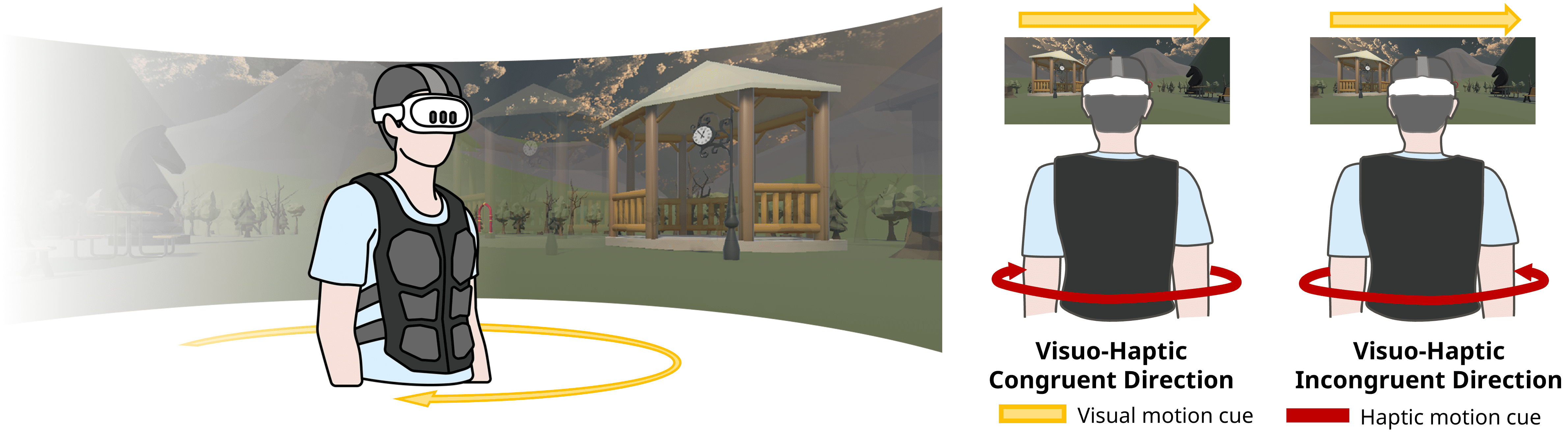
Congruent and incongruent torso-based haptic rotational motion cues were compared during visual yaw rotation in VR to mitigate cybersickness and enhance haptic user experience.
Abstract
Despite rapid advancements in VR, cybersickness remains a critical barrier to comfortable user experiences. Cybersickness is often attributed to sensory conflict between perceived visual self-motion and the lack of corresponding vestibular feedback. We hypothesized that providing tactile motion cues as an alternative for vestibular stimuli could mitigate this conflict. To test this, we conducted an experiment using a haptic vest to deliver torso-based tactile motion cues synchronized with visual rotations in VR, focusing on yaw rotation as a first step. We evaluated sickness levels and UX across different directions (congruent and incongruent) and velocities. Results indicated that tactile motion opposing the visual direction—designed to mimic natural vestibular feedback—significantly reduced cybersickness and improved UX. Interestingly, tactile cues congruent with the visual direction also yielded positive outcomes when delivered at twice the visual velocity. These findings suggest that illusory tactile motion can help mitigate cybersickness without direct vestibular stimulation, highlighting the potential of haptic-based motion compensation for visually induced rotation in VR.
Key Contributions
- 1
First systematic mapping of torso-based rotational haptic motion cues—varying direction (congruent/incongruent) and velocity (1×/2×)—for mitigating yaw-rotation cybersickness in VR
- 2
A Gaussian-based tactile-flow rendering algorithm for a 32-actuator haptic vest, with a single spread parameter (σ ≈ 1.46) shown to stay stable across velocities and torso regions
- 3
A user study (N = 17) showing that opposite-direction cues at matched velocity (vestibular substitution) and same-direction cues at doubled velocity (visual reinforcement) both significantly reduced cybersickness and improved Haptic User Experience (HUX)
- 4
Design implications for VR: amplify velocity for congruent haptic cues, but synchronize velocity for incongruent ones—simple velocity matching alone is not sufficient
Visual-Haptic Motion Generation System
A commercial 32-actuator haptic vest (TactSuit Pro) renders a continuous virtual vibration point that flows around the torso. Intensity is distributed across the closest actuators with a Gaussian profile, and the point's position is updated over time to create a smooth rotational tactile flow synchronized with the yaw-axis visual rotation, at roughly 20 ms haptic latency.
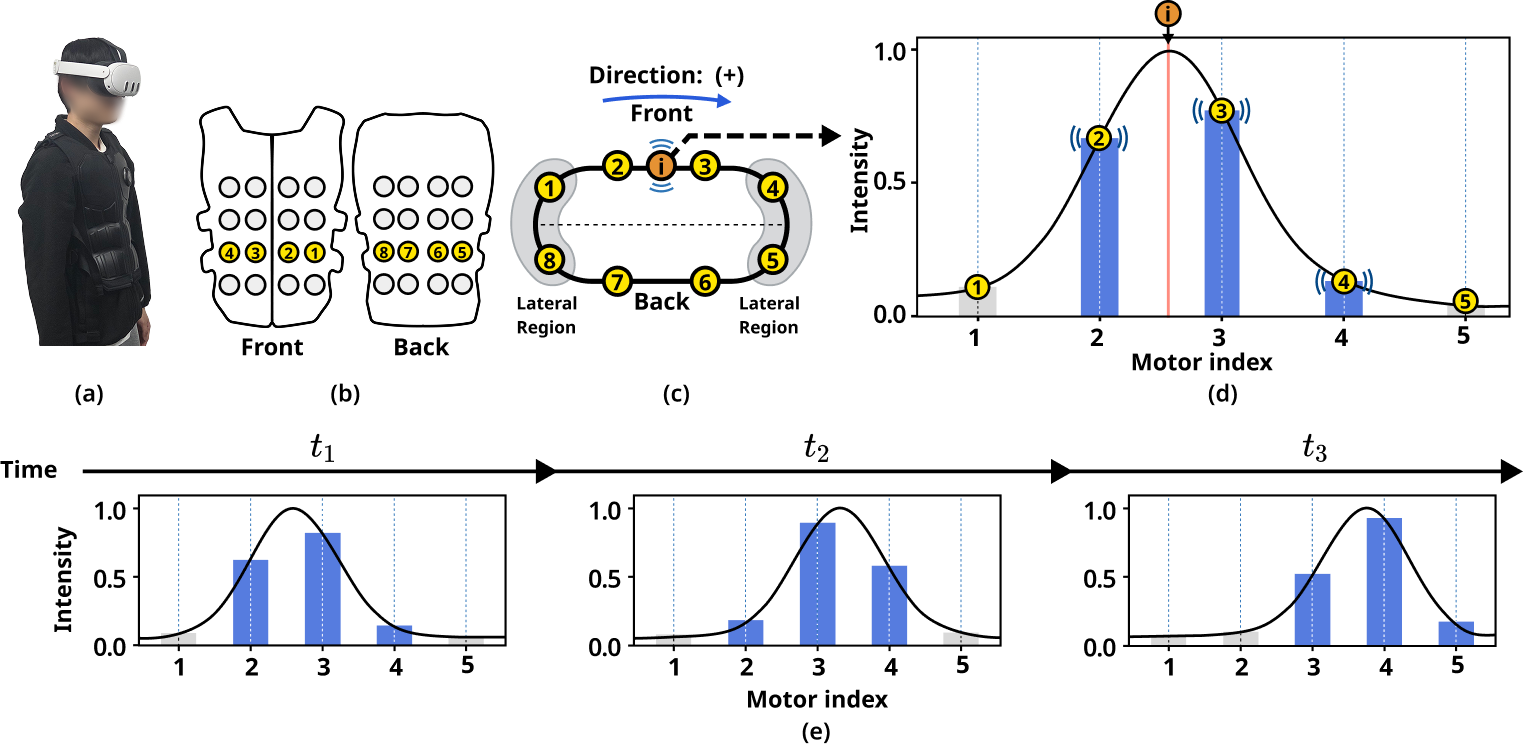
Fig. 2. Actuator layout, Gaussian-based virtual point rendering, and the resulting temporal tactile flow around the torso.
Preliminary Experiment: Optimal Rendering Configuration
Ten participants calibrated their preferred vibration intensity, then tuned the spread parameter σ for a natural rotational flow across three angular velocities and the front/back vs. lateral torso regions, and ranked four candidate vertical stimulation lines. Contrary to expectation, σ stayed remarkably stable (overall mean 1.46) regardless of velocity or region—a single unified configuration was sufficient, and the third line (L3, mid-torso) was preferred as it avoided rib-borne discomfort.
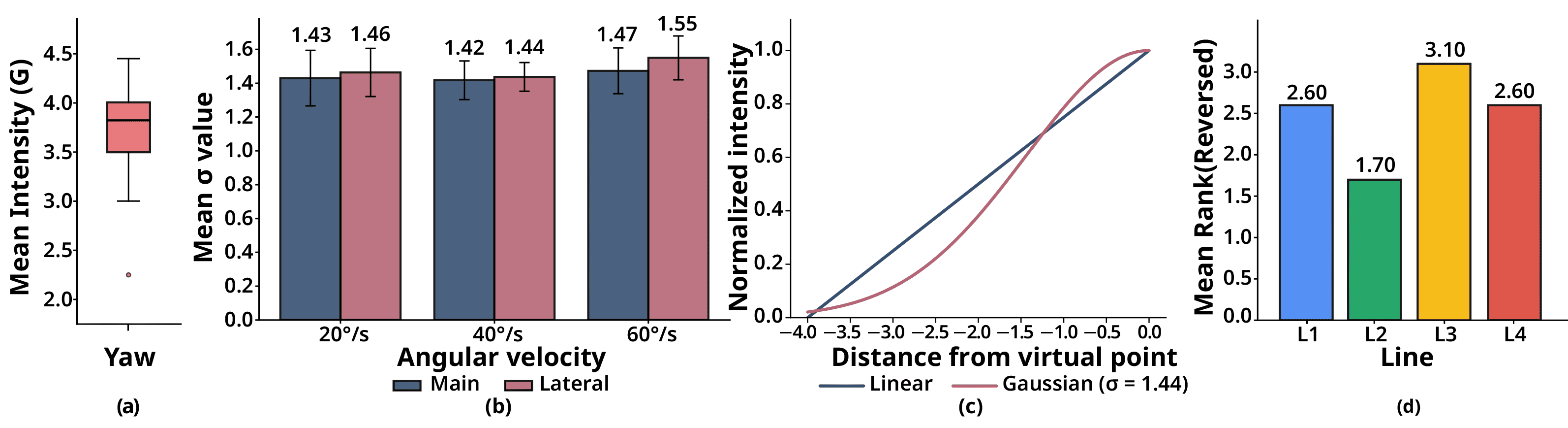
Fig. 4. Preferred vibration intensity, mean σ across velocities and regions, the resulting Gaussian profile, and mean preference ranks for the four candidate lines.
User Experiment: Direction & Velocity Design Space
Seventeen participants (of 22 recruited) experienced a 150 s theme-park VR yaw rotation under five conditions: No-Haptic (NH) and a 2×2 factorial of direction (Same/Opposite) × velocity (1×/2×). Sickness (SSQ, FMS) and Haptic User Experience (Harmony, Autotelics, Immersion, Discomfort) were assessed after every trial.
Opposite x2 velocity
Deviated from the expected vestibular relationship. Weakest and least consistent effect among the four haptic conditions.
Opposite x1 velocity
Mimics natural vestibular feedback (vestibular substitution). Produced the strongest, most consistent sickness reduction across SSQ and FMS.
Same x1 velocity
Matched visual velocity but same direction. Lowered SSQ somewhat, yet showed no HUX benefit over no haptics, congruence alone was not salient enough.
Same x2 velocity
Reinforces the visual motion with a salient illusory spinning sensation. Reduced sickness and, uniquely among same-direction cues, boosted HUX.
Results
- SSQ — VO-1, VS-1, VS-2 all lower than no-haptic (esp. Oculomotor); VO-2 no benefit
- FMS over time — all 4 haptic conditions slow sickness buildup; VO-1 & VS-2 flattest
- HUX — only VO-1 & VS-2 improve Harmony/Autotelic over no-haptic
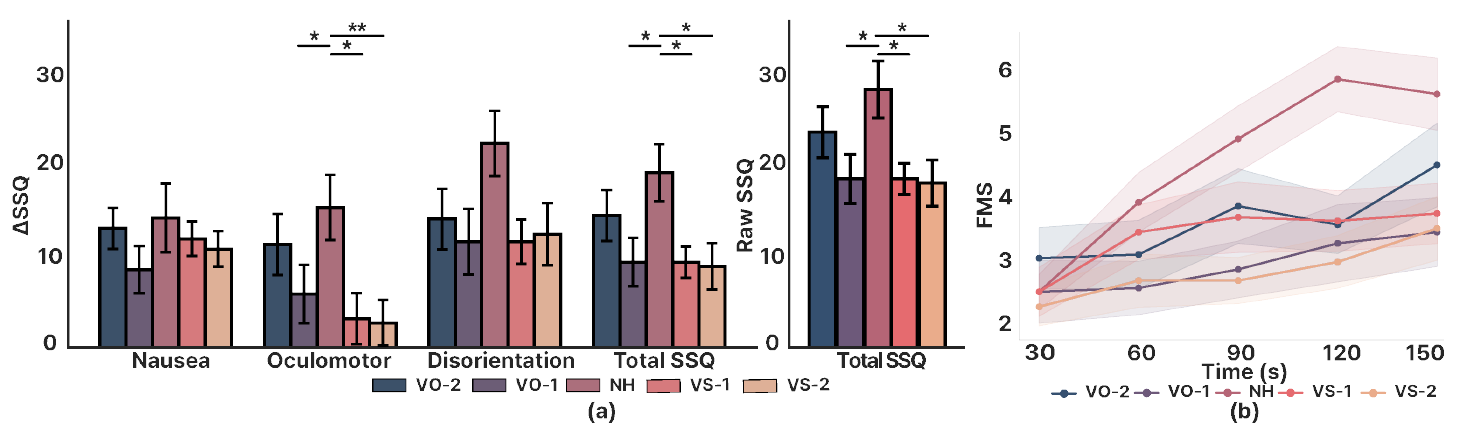
Fig. 6. (a) ΔSSQ and raw SSQ by subscale and condition. (b) Temporal progression of momentary sickness (FMS) over the 150 s exposure.
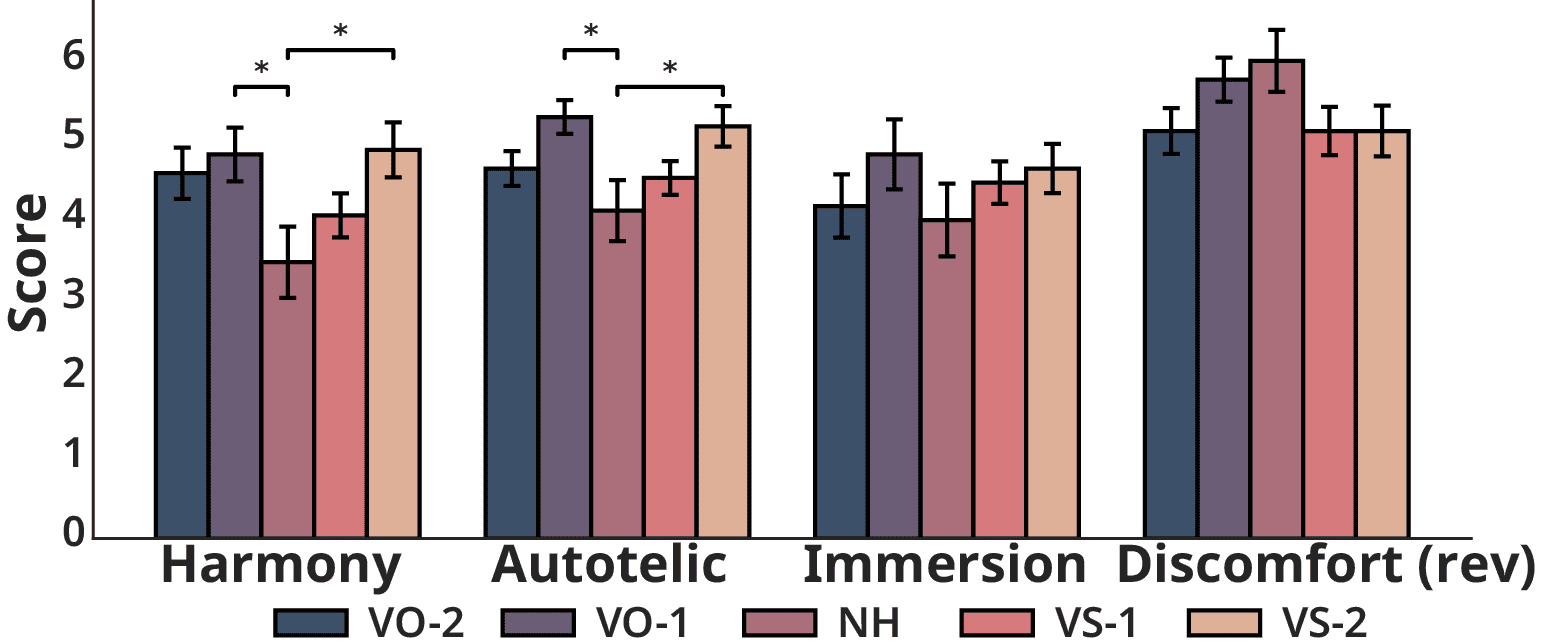
Fig. 7. Haptic User Experience (Harmony, Autotelics, Immersion, Discomfort) by condition. VO-1 and VS-2 both improved HUX; VS-1 did not.
1.46
Optimal σ
Stable across velocity & torso region
−20%
Oculomotor SSQ
VO-1 / VS-1 / VS-2 vs. no-haptic
N = 17
Main Study
22 recruited, 5 excluded for FMS criteria
4
Haptic Conditions
2 (direction) × 2 (velocity) factorial
Design Implications for Rotational VR Experiences
Achieving both cybersickness mitigation and a better haptic experience requires context-aware rendering tailored to whether the cue reinforces or opposes the visual motion.
Continuous motion rendering
Gaussian-based spatial interpolation across multiple actuators produces a seamless tactile flow around the torso.
Amplify velocity for congruent cues
Same-direction haptic motion (VS-1 → VS-2) needs to run faster than the visual speed to become perceptually salient and actually improve HUX.
Synchronize velocity for incongruent cues
Opposite-direction cues (VO-1, not VO-2) work best when matched to the visual rotational speed, facilitating effective illusory self-motion.
Torso-scale, non-invasive feedback
A wearable vest delivers spatial haptic cues without directly stimulating the vestibular system, preserving user comfort.
Citation
@inproceedings{Jin2026:feeling,
    author    = {Jin, Hyeseong and Hwang, Jaehyeong and Park, Chaeyong},
    title     = {Feeling Visual Motion: Mitigating Cybersickness in VR Using Tactile Motion Cues},
    booktitle = {2026 IEEE International Symposium on Mixed and Augmented Reality (ISMAR)},
    year      = {2026},
    note      = {Conditionally accepted, to appear}
}
This work was partly supported by the Institute of Information & Communications Technology Planning & Evaluation (IITP)-ICT Creative Consilience Program (IITP-2026-RS-2020-II201819) and by the National Research Foundation of Korea (NRF) (RS-2026-25483739) grant funded by the Korea government (MSIT).