
Fingertip Pressure Feedback Increases the Perceived Length of a Handheld Object
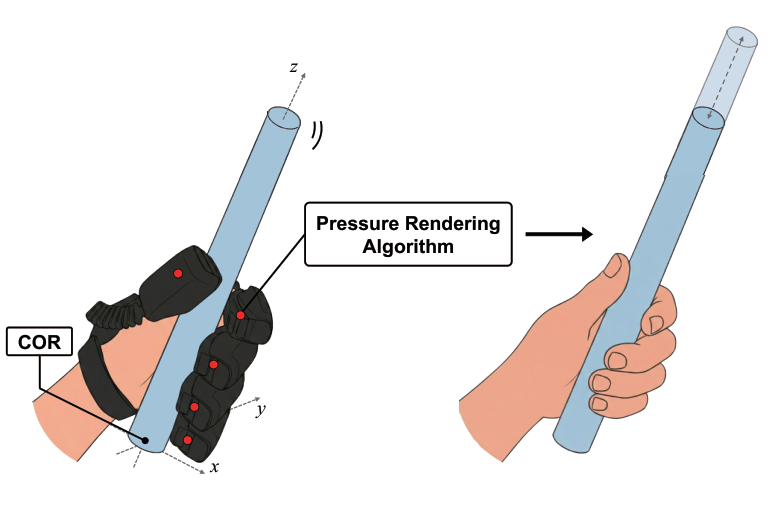
Fig. 1. A haptic glove renders fingertip pressure relative to the center of rotation (left), increasing the perceived length of the rod while its physical length remains unchanged (right).
Abstract
In haptics, supporting dynamic touch, the perception of object properties such as length and shape through wielding, remains a significant challenge, often requiring complex and bulky devices. This paper investigates whether the perceived length of a wielded physical object can be augmented using only dynamic cutaneous (pressure) feedback to the fingertips, motivated by the recent advancement of haptic gloves. We designed pressure feedback profiles inspired by the biomechanical changes in finger pressure that naturally occur during wielding. These profiles deliver sequential pressure stimuli to the fingertips, synchronized with the object's rotational angle during wielding. A perceptual experiment demonstrated that the fingertip pressure feedback significantly increased the perceived length of an elongated object by 6.1% on average. This effect was equivalent to an increase of 13.8% in the physical moment of inertia of the object. This finding suggests that cutaneous feedback can effectively modulate the perceptual properties of handheld objects mediated through dynamic touch, expanding the application areas of hand-worn haptic devices.
Key Contributions
- 1
Proposed modulating the perceived length of a wielded object with fingertip pressure feedback alone, without changing the object's mass distribution or adding bulky inertial displays
- 2
Designed biomechanically-inspired spatiotemporal pressure profiles that flow across the five fingers in sync with the rod's rotation angle during downward and upward swings
- 3
A perceptual experiment (N = 24) showed the dynamic profile increased perceived length by 6.1% on average, while constant pressure had no significant effect
- 4
The effect was equivalent to a 13.8% increase in the physical moment of inertia, showing cutaneous feedback can modulate dynamic touch
Biomechanically-Inspired Pressure Rendering
A commercial haptic glove (WeArt TouchDIVER) presses on the five fingertips while the user wields a custom rod whose moment of inertia is adjusted by a brass weight. The rod angle is tracked in real time, and each finger receives binary (on/off) pressure over a preset angle range. The thumb stabilizes the grip, the ulnar side acts as an anchor, and the radial side brakes the swing, so pressure travels from finger to finger with a small overlap that induces tactile apparent motion.
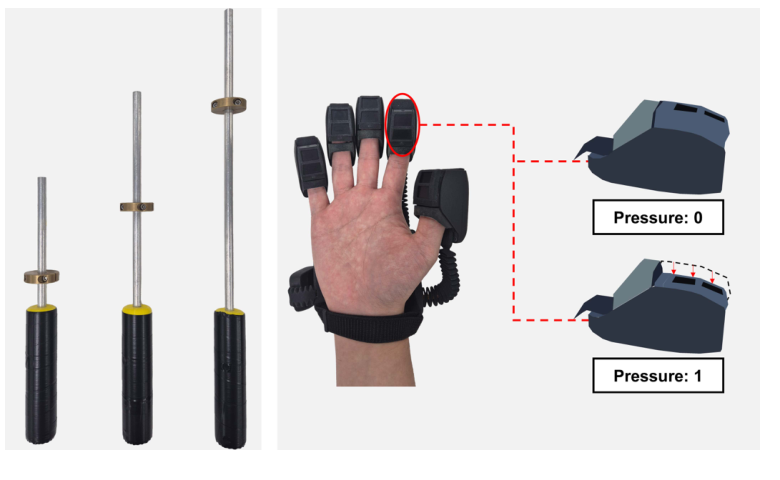
Fig. 2. Rods for the three MOI conditions (left) and the haptic glove with five thimbles (middle). Thimble operation with and without pressure (right).
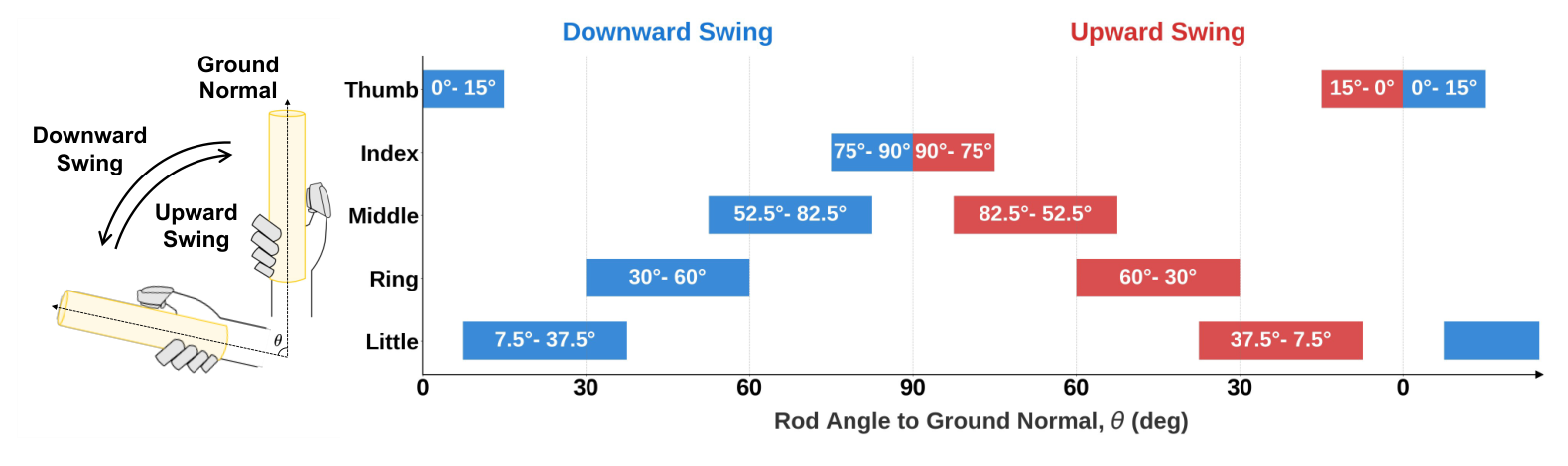
Fig. 3. Rotational direction while wielding (left) and the activation profile of each finger during repetitive swing cycles (right).
Perceptual Experiment
Twenty-four participants wielded rods behind a partition, with no visual information, and rated each rod's length against a reference rod (Medium MOI, no pressure) set to 100. The design crossed three pressure feedback profiles (PFP) with three moments of inertia (Small 300 mm, Medium 400 mm, Large 500 mm) in a within-subjects design.
The glove is worn, but all actuators stay off. Baseline condition.
All five fingers receive maximum pressure throughout the wielding motion. Second baseline.
Sequential pressure flows across the fingers, synchronized with the rod angle during downward and upward swings.
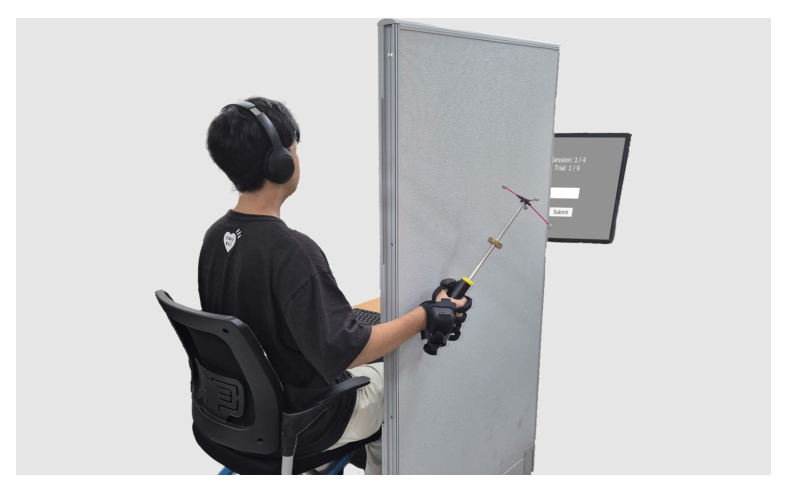
Fig. 4. Experiment setup.
Results
- Pressure profile — Dynamic > None (p < .001) and Dynamic > Constant (p = .002); None vs. Constant n.s. (p = .672)
- Moment of inertia — all three levels differ significantly (p < .001), as expected
- Interaction — not significant (p = .277); the Dynamic effect slightly shrank at larger MOI (7.0% → 6.2% → 5.1%)
+6.1%
Perceived Length
Dynamic vs. None, averaged over MOI levels
+13.8%
Equivalent MOI
Physical inertia needed for the same effect
N = 24
Participants
3 PFP × 3 MOI, within-subjects
108
Trials / Participant
Magnitude estimation with modulus
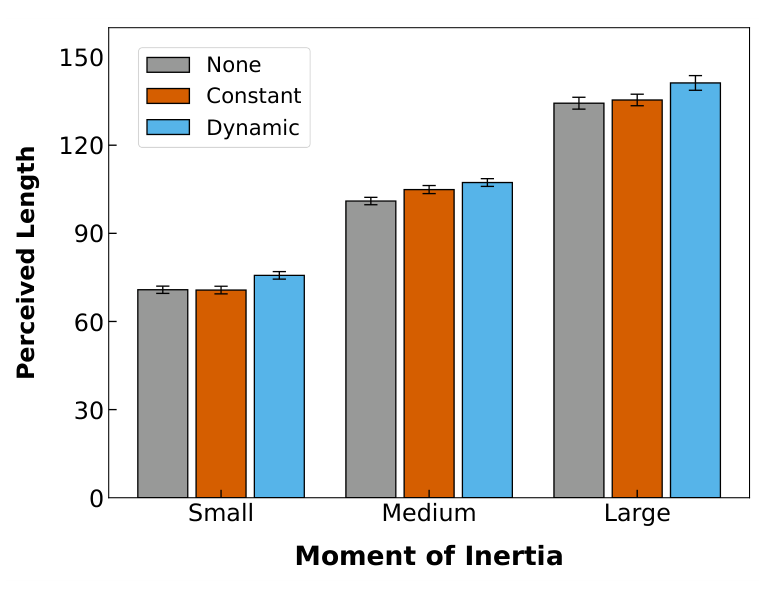
Fig. 5. Mean perceived lengths for each combination of MOI and PFP. Error bars indicate standard errors.
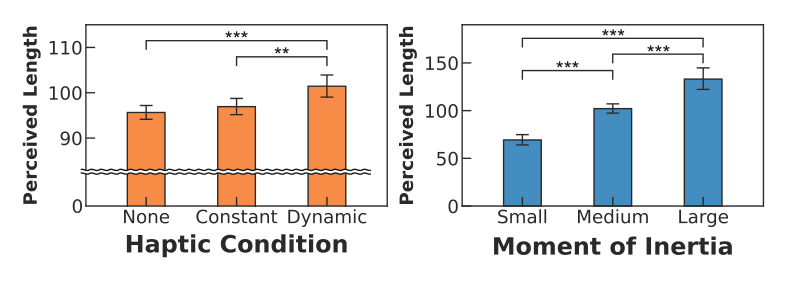
Fig. 6. Geometric means of perceived length for each PFP and MOI level (** p < .01, *** p < .001).
Discussion & Takeaways
Dynamic touch has been served mostly by bulky shape-changing or modular devices. These results show that hand-worn haptic gloves can reach it as well.
Timing matters, not just touch
Constant pressure did not change perceived length; only the cue coupled to the wielding motion was treated as informative.
Fingertip-only rendering
A haptic glove can modulate length perception without moving internal masses, avoiding complex, heavy inertial mechanisms.
Torque-like interpretation
Movement-synchronized pressure may be read as extra torque, cueing a larger inertia and thus a longer object.
Next: intensity and 3D swings
Future work covers continuous pressure scaled to swing speed, free 3D motion, and combining pressure with other tactile cues.
Citation
@article{Kim2026:fingertip,
    author={Kim, Jeongwoo and Park, Hyunyong and Park, Chaeyong and Choi, Seungmoon},
    journal={IEEE Transactions on Haptics},
    title={Fingertip Pressure Feedback Increases the Perceived Length of a Handheld Object},
    year={2026},
    doi={10.1109/TOH.2026.3734692}
}
This work was supported by a grant CRC23021-000 from NST and a grant IITP-RS-2025-02214780 from IITP, both funded by the Korea government.