
Posture-Adaptive Azimuthal Guidance via a Forearm Vibrotactile Interface for VR Navigation
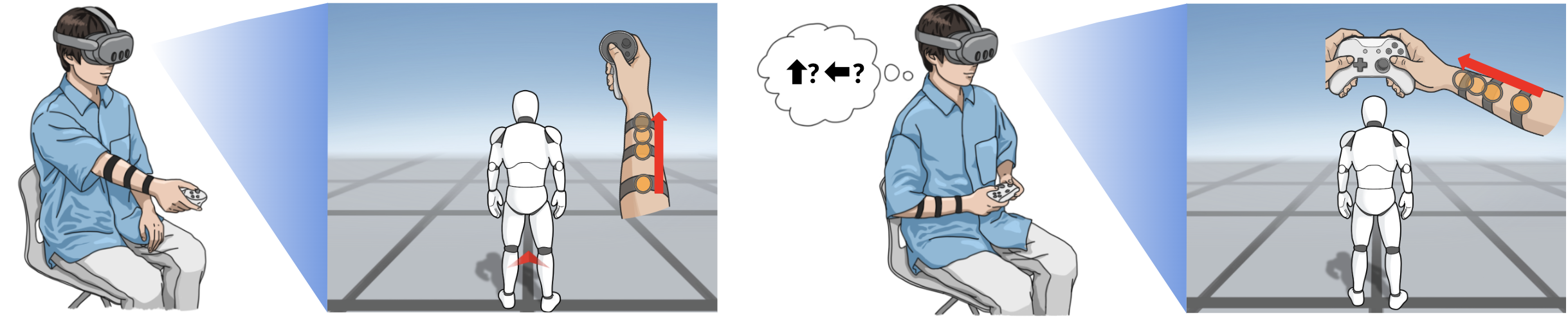
Although identical haptic guidance is provided, the perceived direction varies with arm posture; our posture-adaptive model corrects for this shift so intended and perceived directions align.
Abstract
While forearm-worn interfaces are effective for tactile navigation in VR, variations in arm posture during handheld controller use can distort directional perception. This paper presents a posture-adaptive compensation model designed to deliver consistent 2D azimuthal cues across changes in arm posture. In our first experiment, we quantified how the horizontal body-to-forearm angle and wrist rotation affected perceived azimuth, establishing an empirical basis for our computational model. Notably, the perceptual shift remained substantially smaller than the physical change in the body-to-forearm angle, evidencing hybrid integration of body-centered and device-centered reference frames. Based on these findings, we developed a user-adaptive compensation model that combines a representative-posture model with lightweight user adaptation to render intended azimuthal directions across changes in arm posture. Subsequent VR navigation experiments demonstrated that this user-adaptive model significantly improved directional accuracy and navigation efficiency, outperforming the posture-independent baseline by up to 22.4 percentage points. This work establishes a methodology for posture-adaptive, eyes-free navigation by mitigating posture-dependent distortions in directional communication.
Key Contributions
- 1
Quantified how the body-to-forearm angle and wrist rotation systematically shift the perceived azimuth of forearm vibrotactile cues, revealing a hybrid integration of body-centered and device-centered reference frames
- 2
Developed three posture-compensation models (Individual, Global, User-adaptive) and validated them via Leave-One-Subject-Out simulation; the hybrid User-adaptive Model (w = 0.45) achieved the lowest error
- 3
VR navigation study (N = 18) showed the User-adaptive Model improved directional accuracy by up to 22.4 percentage points and reduced trials-to-arrival by ~20% versus a posture-independent baseline at a 75° body-to-forearm angle
- 4
A short-term learning study (N = 5) showed directional accuracy rising from 51.2% to 86.6% after brief familiarization, confirming practical viability for real-world use
Forearm Vibrotactile Navigation System
Twelve ERM motors are arranged circumferentially and longitudinally across three velcro bands on the forearm. A fixed “anchor” motor always fires first to give a stable reference, followed by a target cue; phantom-sensation rendering across adjacent motors delivers continuous, fine-grained azimuthal cues beyond the physical motor positions.
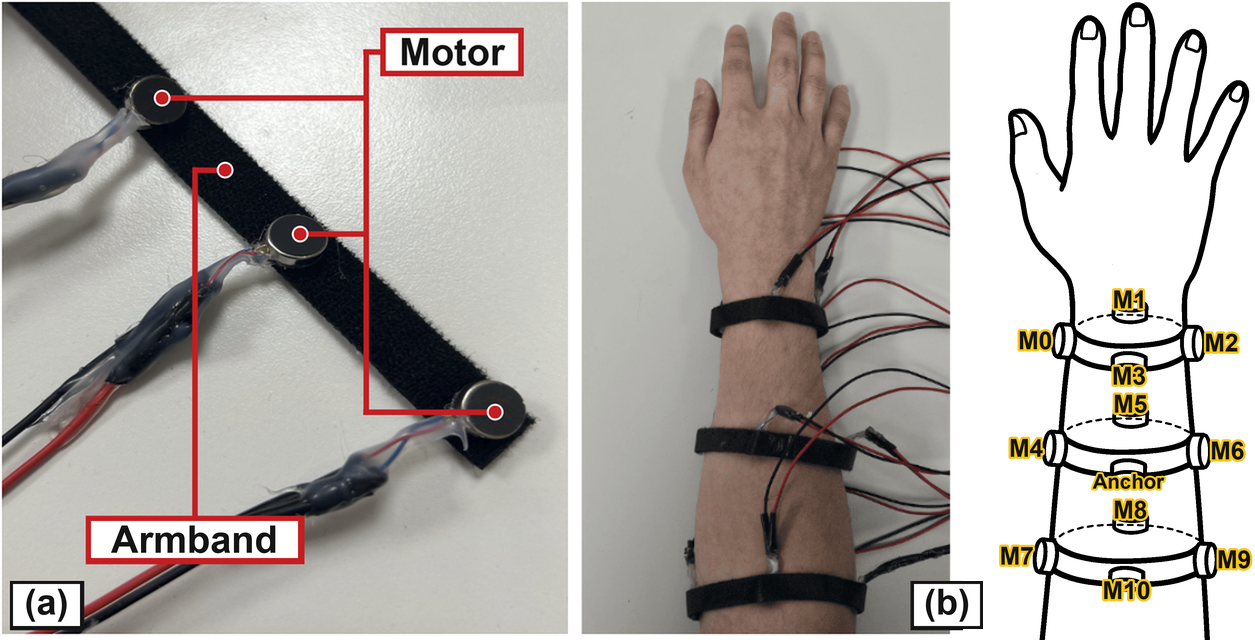
Fig. 2. Armband configuration: 12 ERM motors distributed across three bands around the forearm.
Exp. 1: Azimuth Perception Under Posture Variation
Twenty-four participants judged the perceived direction of vibrotactile cues at three body-to-forearm angles (0°, 45°, 90°) and two wrist rotations. Perceived azimuth shifted systematically with body-to-forearm angle—but by a much smaller margin than the physical change, indicating a hybrid of body-centric and device-centric reference frames. Wrist rotation had only a weak, non-significant effect.
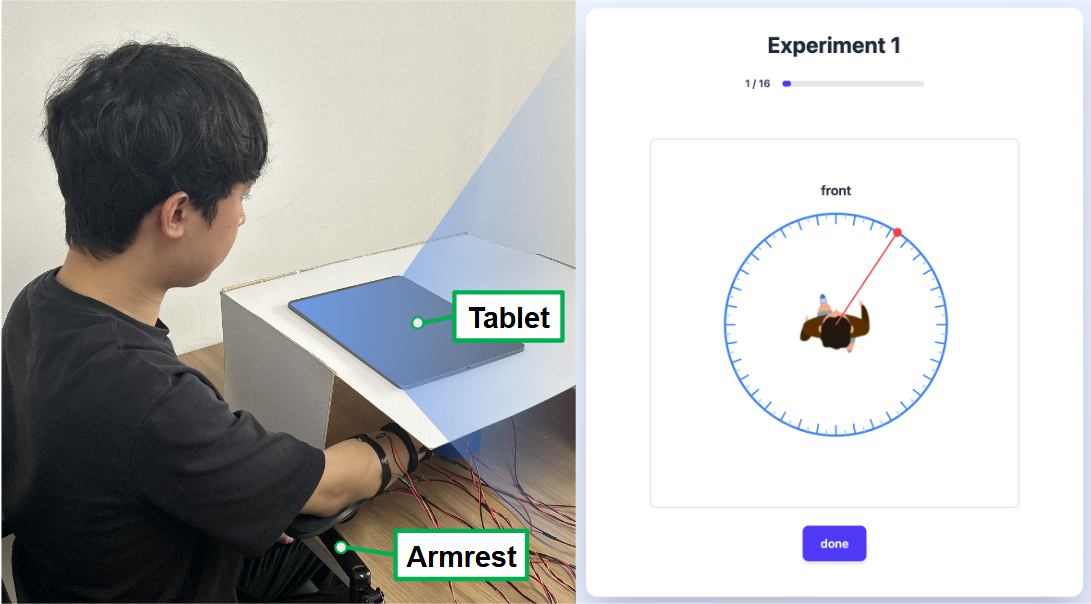
Fig. 5. Experiment 1 setup: the forearm was fixed at each target angle using an articulating arm rest.
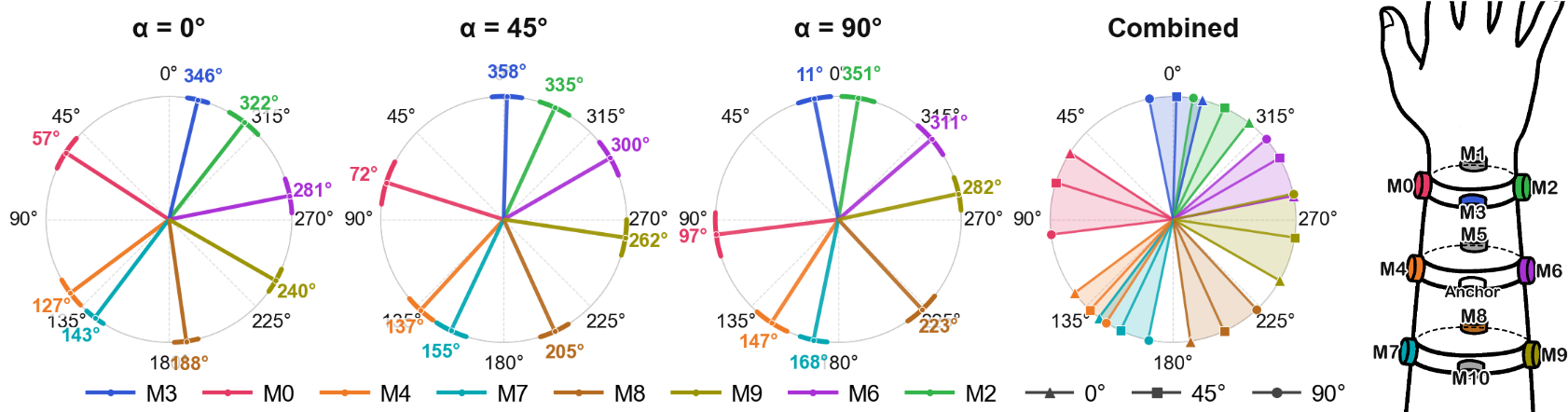
Fig. 6. Circular means of perceived azimuth per motor at 0°, 45°, and 90° body-to-forearm angle.
Posture-Adaptive Compensation Models
Using the Exp. 1 dataset, three compensation strategies were built and compared via Leave-One-Subject-Out cross-validation.
User-specific azimuth profile built from a single participant's own calibration trials. Most tailored, but costly to collect and hard to generalize.
Mean perceived-azimuth profile pooled across all participants. Consistent out-of-the-box, but does not reflect individual variation.
Hybrid of GM and few-shot IM data (SUM = w·SIM + (1−w)·SGM). Balances generalizability with personal calibration at low cost.
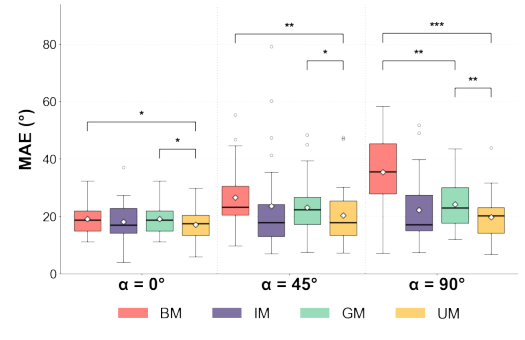
Fig. 8. Simulation results by method and posture. UM matches IM's accuracy with much lower variance, especially at larger body-to-forearm angles.
Exp. 2: Posture-Adaptive VR Navigation
Eighteen participants navigated haptics-only VR mazes at two novel body-to-forearm angles (30° and 75°, reflecting HMD-controller and game-console-controller postures) using the Baseline (BM), Global (GM), and User-adaptive (UM) models. At the challenging 75° posture, UM reached 67.2% directional accuracy versus 44.8% for BM and 51.3% for GM, and required ~20% fewer trials to reach the destination.
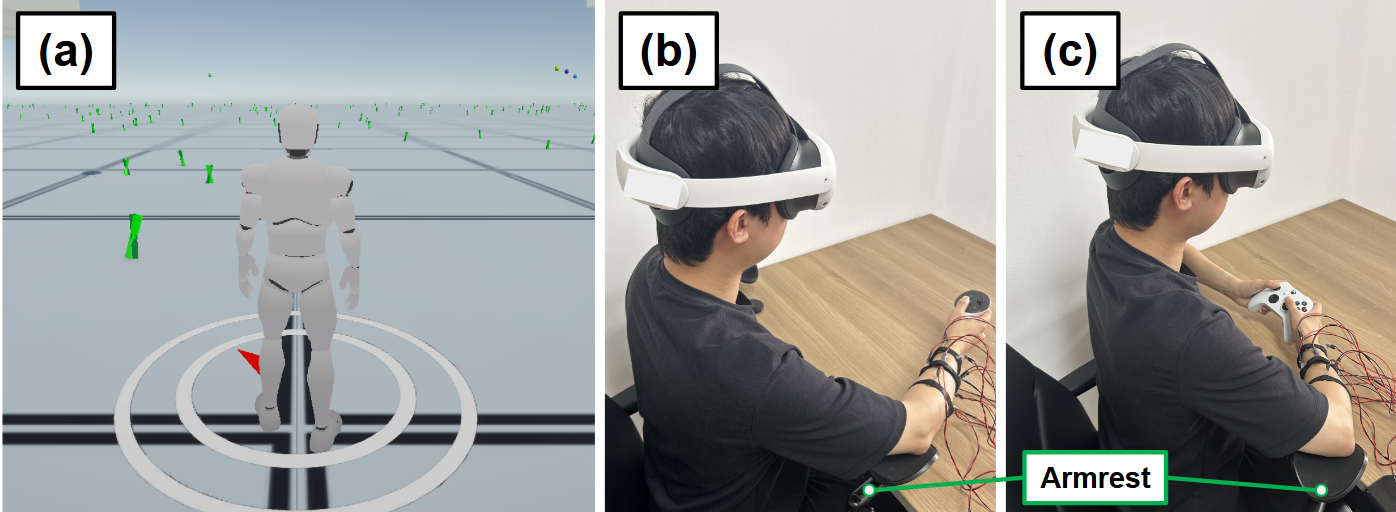
Fig. 10. (a) VR navigation scene; (b, c) 30° and 75° body-to-forearm postures with HMD and console controllers.
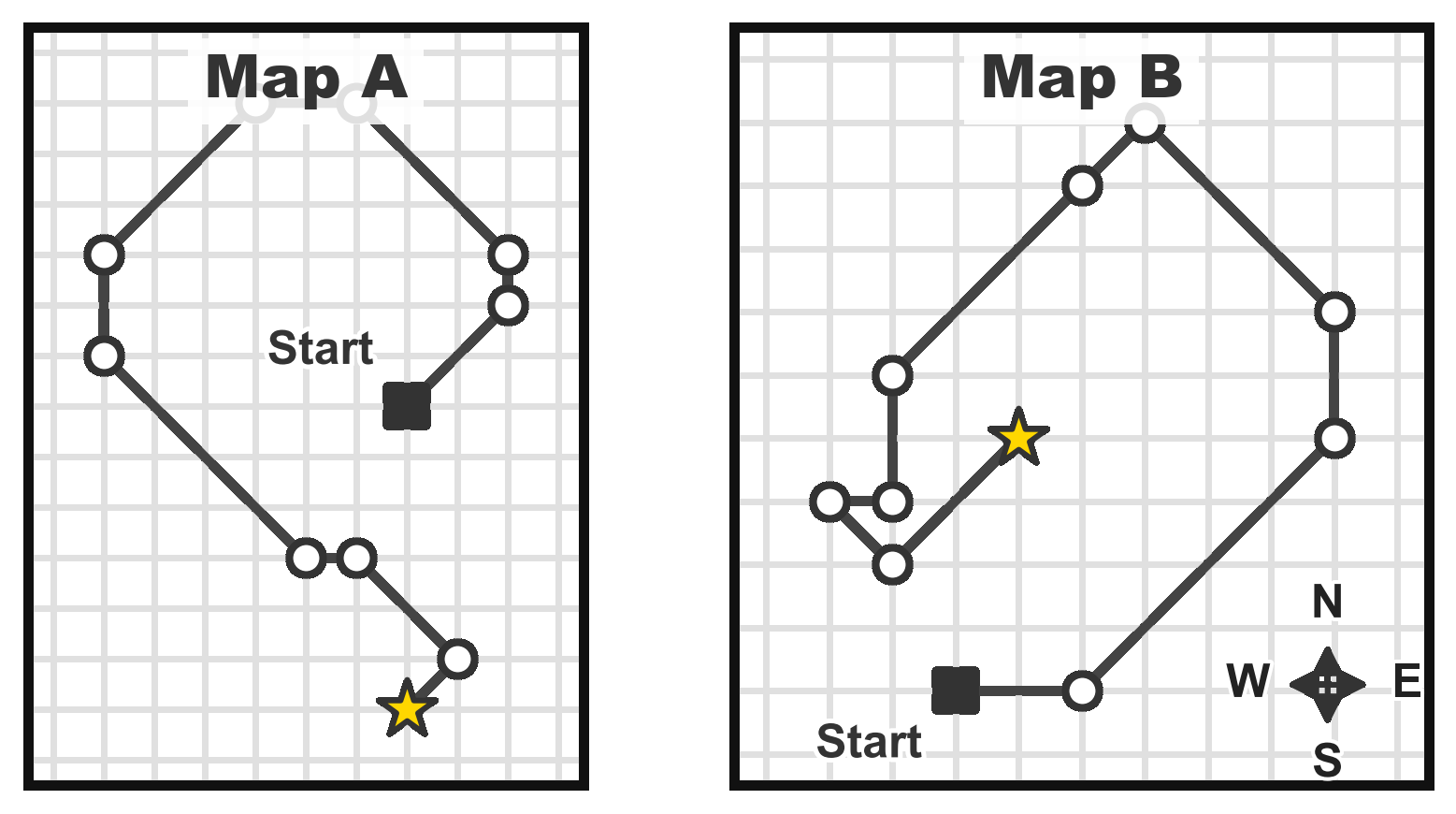
Fig. 11. Example navigation maps; squares mark start points and stars mark destinations.
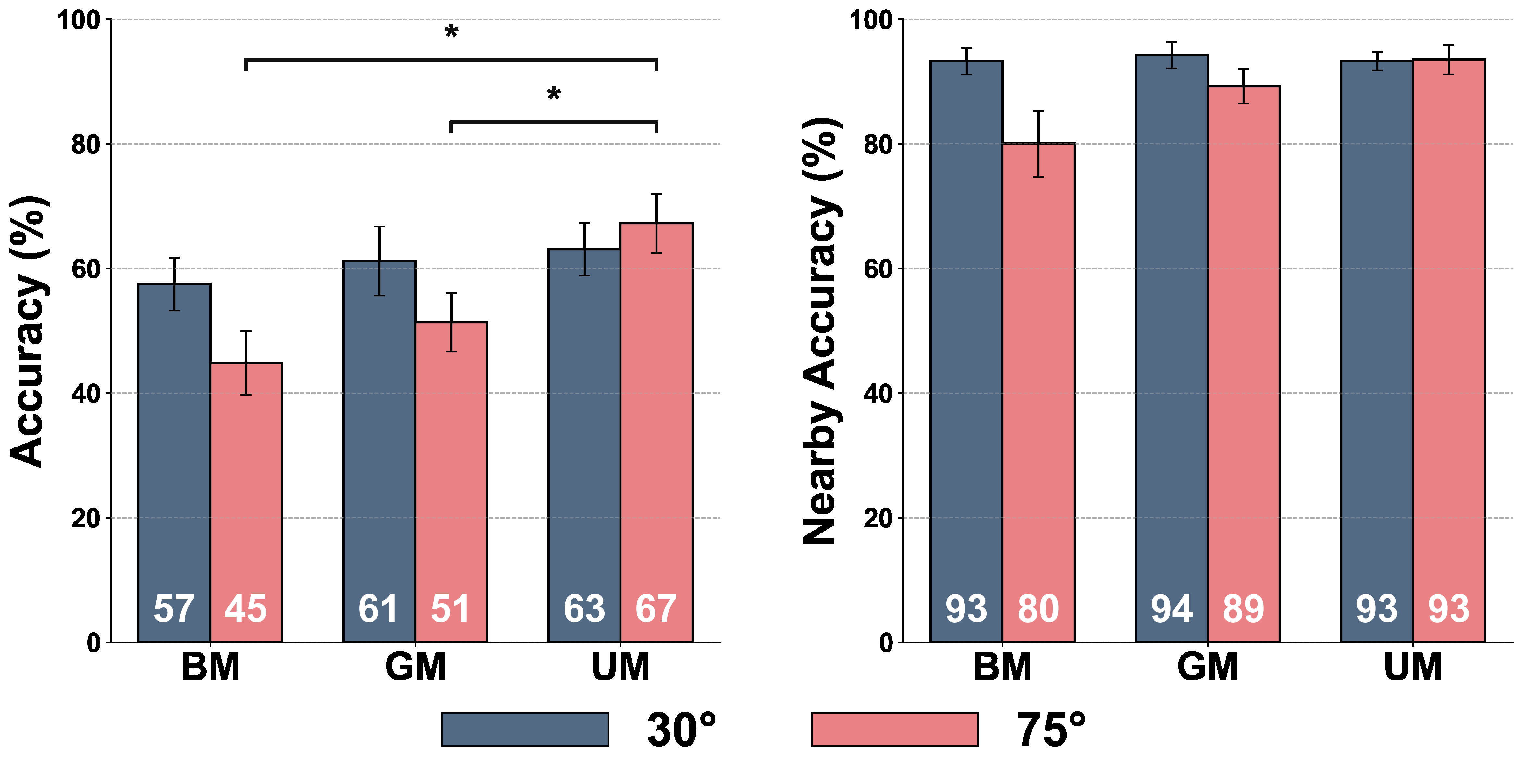
Fig. 12. Directional accuracy and nearby accuracy by method and posture.
Headline Results & Short-Term Learning
A follow-up summative study gave five participants a brief training-practice cycle with the User-adaptive Model at 75°. Directional accuracy rose from 51.2% to 86.6% (+35.4 percentage points, p < .01), confirming that the compensation model pairs well with rapid tactile-spatial learning.
30.7°
Avg. Perceived Shift
vs. 90° physical body-to-forearm change
19.08°
Min. Model MAE
User-adaptive Model at w = 0.45
+22.4pp
Accuracy Gain
UM vs. baseline at 75° posture
86.6%
Accuracy after Training
Up from 51.2% before familiarization
Citation
@article{Hwang2026:posture,
    author={Hwang, Jaehyeong and Jin, Hyeseong and Park, Chaeyong},
    journal={IEEE Transactions on Visualization and Computer Graphics},
    title={Posture-Adaptive Azimuthal Guidance via a Forearm Vibrotactile Interface for VR Navigation},
    year={2026},
    volume={X},
    number={X},
    pages={XXXX-XXXX},
    doi={10.1109/TVCG.2026.3747524}
}
This work was partly supported by the Institute of Information & Communications Technology Planning & Evaluation (IITP)-ICT Creative Consilience Program (IITP-2026-RS-2020-II201819) and by the National Research Foundation of Korea (NRF) (RS-2026-25483739) grant funded by the Korea government (MSIT).