
Cybersickness Reduction Effects of Visual and Vestibular Player-Fixed Rest Frames
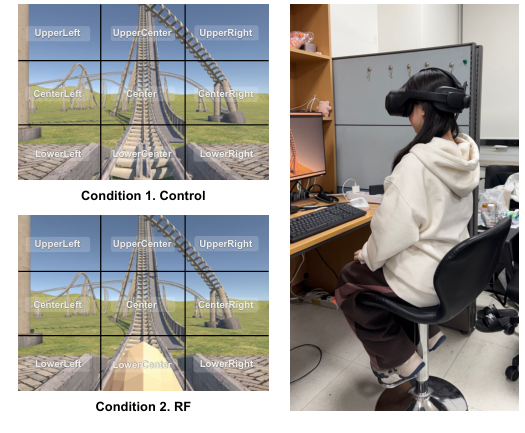
A player-fixed rest frame (virtual nose) provides a stable egocentric reference during visually induced motion in VR.
Abstract
Player-fixed rest frames (RFs) such as virtual noses have been proposed as cybersickness mitigation cues, yet their underlying mechanisms remain unclear. This study investigates how a player-fixed RF influences cybersickness, eye movement behavior, and perceived orientation during passive visually induced motion. In two experiments using a virtual roller coaster with eye tracking, we found that a player-fixed RF reduced overall cybersickness without compromising presence or vection, and promoted a more centralized gaze distribution that progressively diverged from the control condition over repeated trials. However, because the RF's presence and its alignment with upright were confounded in this setting, a second experiment introduced a visual–vestibular conflict through scene tilt. Under this conflict, only an RF aligned with gravitational (vestibular) upright suppressed the cumulative buildup of sickness and preserved veridical orientation perception, whereas an RF aligned with the tilted visual scene did not. These results suggest that a player-fixed RF operates through at least two channels: redistributing gaze away from destabilizing peripheral motion, and serving as an egocentric orientation reference whose effectiveness may be further enhanced by its congruence with vestibular upright.
Key Contributions
- 1
Two eye-tracking experiments (N = 20, N = 24) show a player-fixed rest frame (virtual nose) reduces cybersickness (SSQ, FMS) without harming presence or vection, and drives a gaze pattern that centralizes progressively over repeated exposure
- 2
By tilting the visual scene 30° to dissociate visual from vestibular upright, shows that only a rest frame aligned with true gravitational upright suppresses the cumulative buildup of sickness and preserves accurate perceived verticality (SVV)—a visually-aligned cue does not
- 3
Proposes a two-channel account of player-fixed rest frames: a scenario-dependent gaze-redistribution/occlusion effect, and an orientation-reference effect tied to vestibular congruence that generalizes across visual-motion contexts
- 4
Reconciles conflicting prior findings on virtual-nose efficacy in the literature by showing that cue congruence—not mere visibility—determines effectiveness
Exp. 1: Does a Rest Frame Reduce Sickness — and How?
Twenty participants rode a passive, upright VR roller coaster for eight repeated one-minute trials, once with a virtual-nose rest frame and once without, while an eye tracker recorded gaze. The RF condition showed significantly lower SSQ Oculomotor, Disorientation, and Total scores, and a Fast Motion Sickness (FMS) score that climbed roughly twice as slowly as Control—with no cost to presence (IPQ) or vection. Seventeen of 33 ocular variables shifted significantly: fixations moved away from the lower visual field (where the nose sat) toward the screen center, saccades grew smaller and more frequent, and this centralization strengthened progressively across the eight trials, tracking the same timeline as the FMS divergence.
20
Participants
Passive VR roller coaster, eye tracked
2 × 8
Design
Control vs. RF × 8 repeated trials
0.706 → 0.375
FMS Slope / Trial
Control vs. RF (47% slower accumulation)
17 / 33
Ocular Variables Shifted
Gaze centralized toward screen center
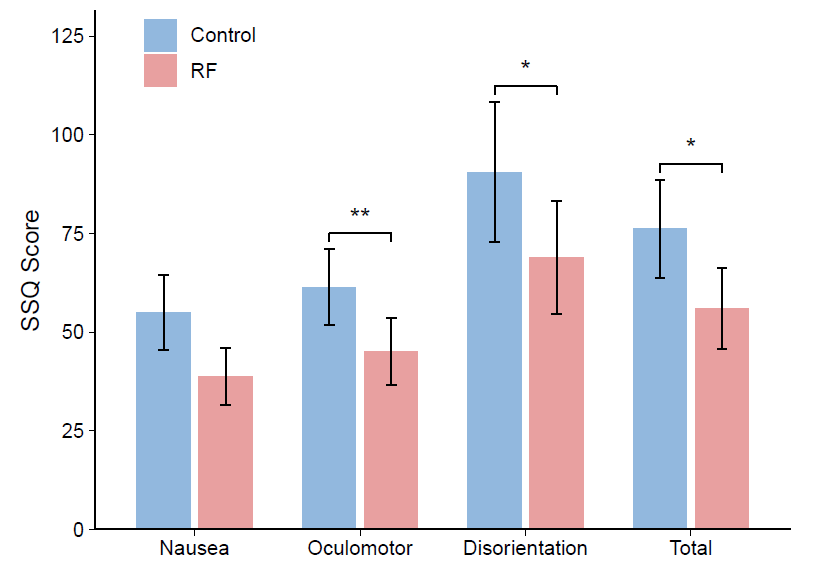
Fig. 2. Mean SSQ subscale scores by condition. RF was significantly lower on Oculomotor, Disorientation, and Total.
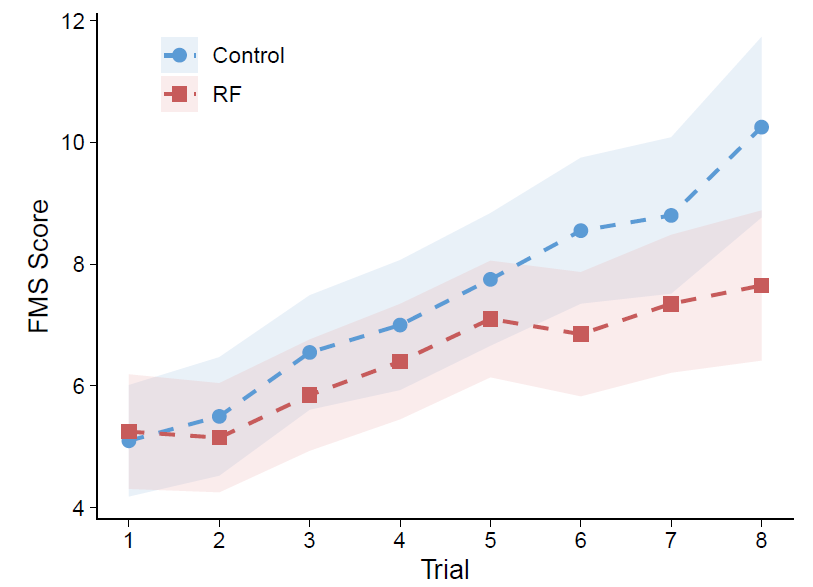
Fig. 3. Mean FMS ratings across trials. RF's sickness accumulated at roughly half the rate of Control.
Exp. 2: Separating Occlusion from Orientation
In Exp. 1, the rest frame's presence, its alignment with the (upright) visual scene, and its alignment with vestibular upright were all confounded. Exp. 2 tilted the entire scene 30° while participants stayed physically upright, then compared no cue against two rest frames—one kept at the real, gravity-aligned nose position (Vestibular G-Cue) and one rotated with the tilted scene (Visual G-Cue)—while also measuring Subjective Visual Vertical (SVV) to track perceived gravity.
T-Control
30°-tilted scene with no rest frame. Fastest cybersickness buildup and largest, most unstable perceived-vertical error.
Visual G-Cue
Rest frame rotated with the visual scene. Reduced overall FMS somewhat, but its rate of buildup mirrored T-Control, and it did not help perceived verticality.
Vestibular G-Cue
Rest frame kept at the real, gravity-aligned nose position. Only this condition flattened the sickness-accumulation slope and preserved accurate subjective visual vertical.
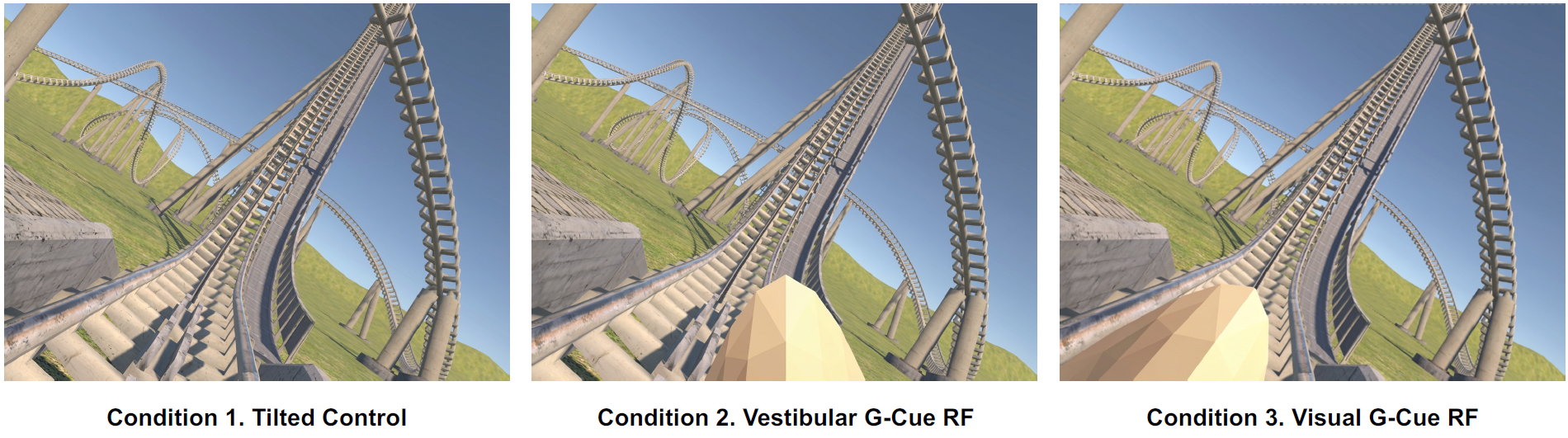
Fig. 5. The three Experiment 2 conditions: the scene was tilted 30° while the rest frame stayed at true upright (Vestibular G-Cue) or rotated with the scene (Visual G-Cue).
24
Participants
3 × 4 within-subject, 30° scene tilt
1.375 → 0.554
FMS Slope / Trial
T-Control vs. Vestibular-aligned RF
r = 0.84
SSQ Disorientation & Total
Vestibular RF vs. T-Control, largest effect sizes
2
Dissociable Channels
Gaze redistribution + orientation reference
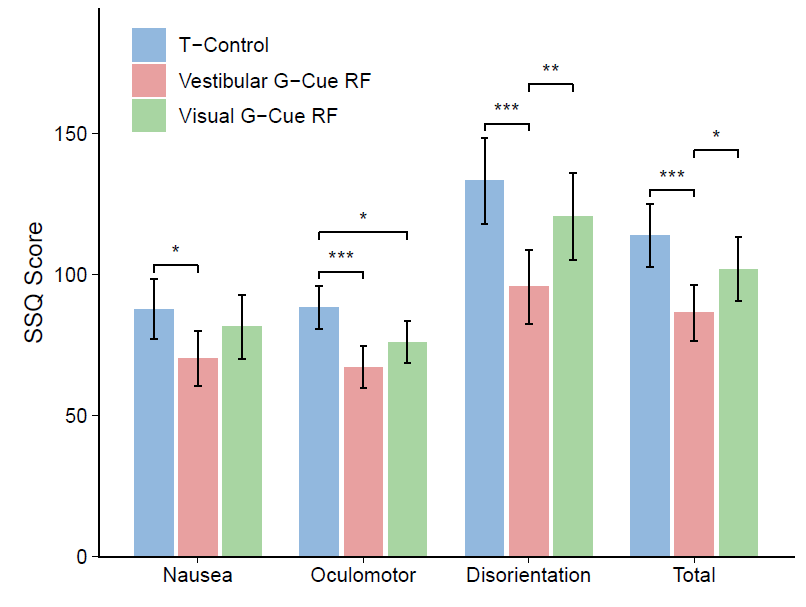
Fig. 7. Mean SSQ subscale scores by condition. Vestibular G-Cue RF was lowest across all subscales.
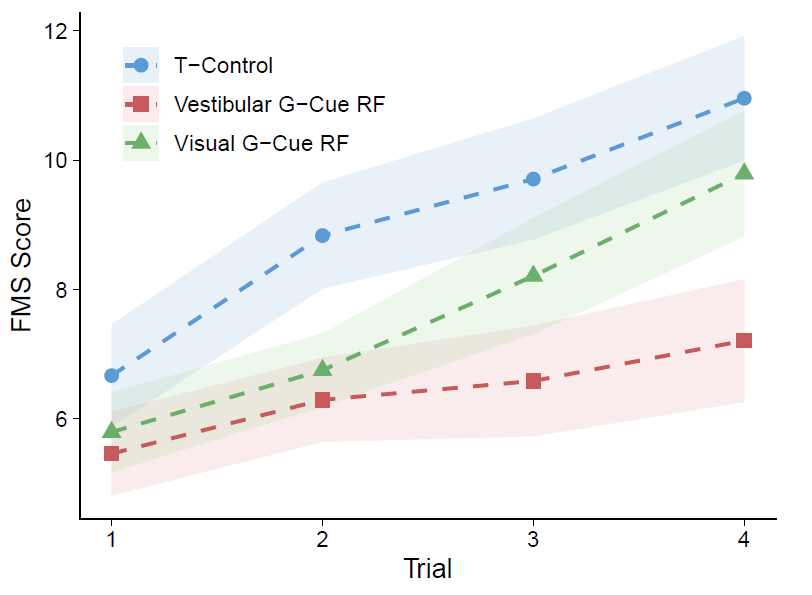
Fig. 8. Mean FMS ratings across trials. Only the vestibular-aligned RF flattened the sickness-accumulation slope.
A Two-Channel Account of Player-Fixed Rest Frames
Together, the two experiments suggest that a player-fixed rest frame is not a single, unitary manipulation—it acts through two at least partially separable channels, which explains the mixed findings on virtual-nose efficacy across the prior literature.
Channel 1 — Gaze redistribution
The rest frame's mere presence draws gaze away from the destabilizing lower/peripheral visual field toward a centralized viewing strategy. Its benefit scales with how much destabilizing optic flow actually falls within the occluded region.
Channel 2 — Orientation reference
When the rest frame is congruent with gravitational upright, it also functions as a stable egocentric reference for self-orientation—suppressing the cumulative buildup of sickness and preserving veridical verticality judgments.
Both channels usually align
In most everyday VR content the scene remains upright, so a player-fixed rest frame naturally satisfies both channels at once—explaining why virtual noses are broadly, if inconsistently, reported as helpful.
Design implication
Cue placement (what it occludes) and cue alignment (what upright it represents) should be treated as two independent levers when designing cybersickness mitigation cues, not a single unitary manipulation.
Citation
@article{kim2026:cybersickness,
    author={Kim, Jungha and Park, Seunghoon and Park, Chaeyong and Lee, Sun-Uk and Kim, Gerard J.},
    journal={IEEE Transactions on Visualization and Computer Graphics},
    title={Cybersickness Reduction Effects of Visual and Vestibular Player-Fixed Rest Frames},
    year={2026},
    volume={XX},
    number={X},
    pages={XXXX-XXXX},
    doi={10.1109/TVCG.2026.3747491}
}
This work was partly supported by MSIT Korea under the Global Research Support Program in the Digital Field Program (RS-2024-00431357), and the ICT Creative Consilience Program (IITP-2026-RS-2020-II201819), through the Institute of Information & Communications Technology Planning & Evaluation (IITP).